What is a content engineer?
By Peter Springett · 7 October 2026
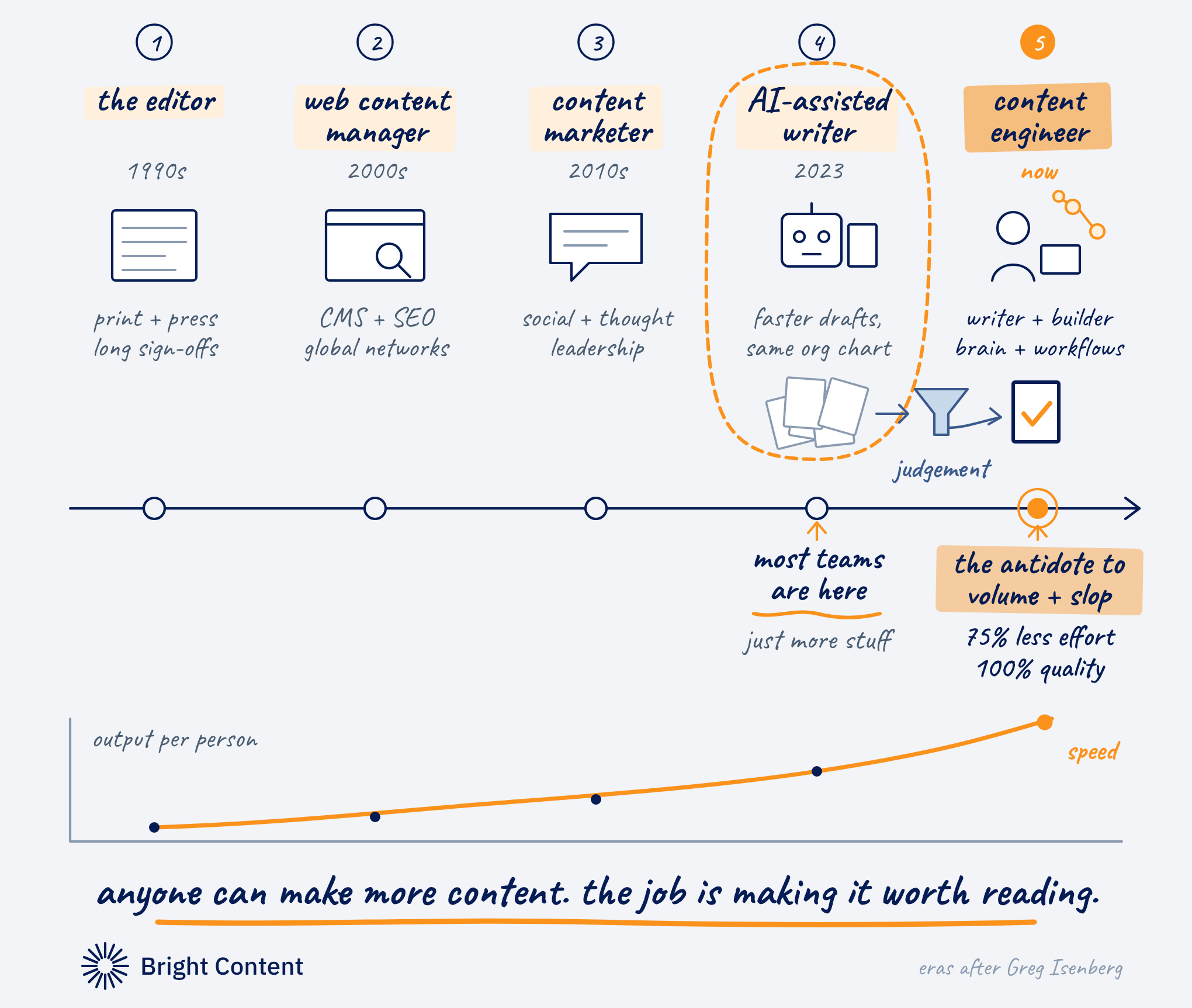
Ethan Mollick calls it the overhang: the gap between what today's AI can already do and what most people actually use it for. In marketing and content teams, that gap has a clear shape, which you'll recognise in the diagram below.
Most teams are at stage four. They use AI to write faster drafts. The org chart, the approval chain and the six-week copy cycle haven't changed. The result is more content, not better content. And if you've still got an approvals loop, you're just adding bottleneck of slop to the business.
Closing the gap, getting to stage five, means working with a content engineer: someone who can write and build. Instead of force-feeding the process, they set up the workflows, the context and the checks, so a team publishes work worth reading with a fraction of the effort.
What does the job actually involve? Good question, here's the job description.
Title: Content Engineer. Or Head of Content, with engineering as the primary function.
Reports to: Head of Marketing or CMO. In an agency, the managing director or head of delivery.
The content engineer runs the content operation and builds the machine it runs on. They write, edit and commission like any senior content lead. They also design the AI workflows and set the rules that keep the output accurate and on brand.
What they do
• Own the content strategy, the editorial calendar and the quality bar.
• Map the content process end to end, and find where the hours actually go.
• Decide which steps AI can manage, what people should do, and where a person must sign off.
• Write and edit the pieces that matter most: thought leadership, research, customer stories.
• Turn sales calls, support tickets and expert interviews into the raw material for content.
• GEO-SEO: Track whether your company shows up when search intent should lead buyers to your assets via Gemini, ChatGPT, Claude or Perplexity.
• Train the team to run the workflows, then step back.
What they build
• The brain. Who the customer is, how the brand sounds, and what the company believes. Written down once, with real examples, so every workflow starts from the same context.
• The workflows. Research, drafting, fact-checking, editing and repurposing, wired together so one interview becomes a month of content.
• The checks. Automated reviews that catch weak claims, wrong stats and off-brand copy before an editor has to.
• The guardrails. Drafts, never sends. Nothing publishes without a person approving it. This rule lives in the tools, not in a prompt.
What this role isn't
• Not a prompt engineer. Today, most models are better prompt-engineers than their users. The value lies in the system that contains the prompt.
• Not the other kind of content engineer. In documentation teams, the title means structured content and CMS architecture. Useful work, different job.
• Not a replacement for writers. The workflows remove the drudge work. Writers spend their time on interviews, ideas and the edit that makes a piece land.
• Not a volume machine. If the plan is to publish ten times as much, this is the wrong hire. The point is better work for less effort, not more of the same.
How success is measured
• Effort: around 75% less production time per piece. (Researching, writing and checking my own weekly newsletter went from eight hours to two).
• Quality: the same or higher. Editors and subject experts sign off faster, with fewer rounds.
• Accuracy: no wrong stats or invented quotes reach a reviewer.
• Visibility: the company appears in AI answers to its buyers' questions, and the count goes up quarter on quarter.
• Independence: This can be a fractional hire. After three months, the team runs the workflows without the person who built them with a retainer of two days per quarter for a year.
Person specification
Every job description ends with the qualities the person needs. This is where the content engineer differs most from the content jobs of five years ago. Mollick names four human advantages that matter more, not less, as AI gets better. Here's what they look like in a content team.
Deep knowledge. Expertise is how you spot where AI is confidently wrong. Someone who has spent years in fintech or cybersecurity reads a draft and knows which claim a compliance officer will reject.
Wide knowledge. Breadth is how you ask for the right thing. Editorial, SEO, social, design and enough code to wire a workflow together: each one gives you the words that get a better result. A content engineer borrows from every discipline they've worked in.
Taste. When making content is cheap, judgement is everything. Taste decides which ideas get made, which drafts get cut, and which piece deserves a reader's ten minutes. It's the difference between stage four and stage five.
Agency. Mollick describes it as "a willingness to test the boundaries of what's possible". In practice, that means building the workflow yourself instead of waiting for a vendor to ship the feature.
Let's be fair. Good editors have always had these qualities. What's changed is that most people can now access tools that enable them to churn out reams of slop: uninspiring, indistinguishable content that grabs no one's attention and is ignored by SEO.
That's where the content engineer comes in. Using well-earned editorial judgement and discrimination, they keep content within factual and legal boundaries while enabling creativity and imagination to soar.
Hiring for this?
Anyone can make more content. The job is making it worth reading.
If you're hiring a content engineer, or want to test the water before you commit, start with a free audit of your content. You'll see what's working, where you're invisible in AI search, and whether your brand is ready for AI workflows. Get in touch at Bright Content, or message me on LinkedIn:
Peter Springett, Bright Content
The eras illustration is adapted from Greg Isenberg's piece on marketing engineers. The four human advantages are from Ethan Mollick's The Overhang.