The first wave of AI-natives is about to hit. Are you ready?
By Peter Springett · 14 May 2026
The past couple of days I’ve been thinking about what it would be like to be 21 again. But it’s not a mid-life crisis. I’m just putting myself in the shoes of what passes as an AI native. Somebody who’s been using AI for nearly four years and is now about to enter the workplace.
Imagine having survived Covid lockdown, been gifted ChatGPT 3.5 and passing GCSEs, A-levels and a degree. You’ve gone from prompting in 2023 to orchestrating agents and building apps in 2026 with Cowork, Codex and Gemini.
Where OpenAI was once a tab on your browser, Cowork or Codex are now the primary operating systems on your desktop. They are the home screen. The place where you organise, create, publish and share with friends, family and potential employers.
But here’s what most employers are missing about this generation. The environment they’ve grown up in doesn’t have a clean boundary between work and play. The same tools, the same instincts, the same problem-solving capability that built a website for a friend’s band or coded a game to share with friends. That’s the same capability that builds a business workflow or a client-facing app.
A 21-year-old who spent their late teens building things for fun in an AI environment has accumulated serious technical and creative capability. It just won’t show up on a traditional CV, and your standard interview process almost certainly won’t find it. This generation hasn’t been consuming AI and building with it. But most hiring processes are blind to it.
And there’s the rub. If you’re used to running local agents on your laptop, imagine how it feels when you join as an intern and they hand you a PC where your primary workspace is one of the two big productivity suites, a browser and a handful of in-house applications with a UX that looks like it was built from the rubble of the dot-com crash.
This isn’t the first time that graduates have turned up their nose at out-of-date technology. But that was very much the prerogative of STEM graduates and maybe creatives confronted with a PC rather than a Mac. Today, everyone from the sciences to the humanities who enters the job market is an AI native.
No doubt many organisations will point to Copilot or Gemini add-ons. But that’s just adding insult to injury. Access to a tool is not an AI-native environment. This matters more than ever as AI continues to create jobs, and as businesses unfreeze hiring policies that exclude graduates and interns.
PwC plans to increase graduate intake in the next 12 months. Research from Gallup indicates that overall, companies that have adopted AI have contributed to jobs growth. Other trends suggest that employers are keen to embrace the home screen revolution.
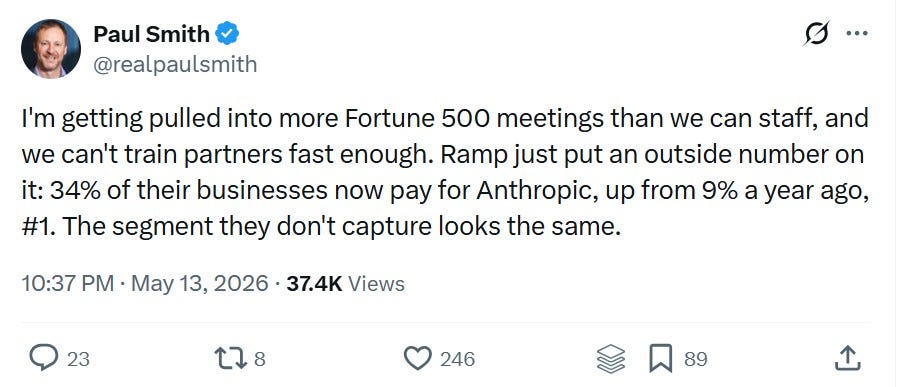
New data suggests that Anthropic is tearing up the corporate sector, overtaking OpenAI when it comes to organisations spending on AI for the first time. Claude Cowork, with the appropriate guardrails, is the agent platform of choice. Anthropic’s CCO is swamped with enquiries from the Fortune 500.
All this means that we are turning a page. Graduates are ready. The tools are ready. It’s now up to employers to create a welcoming environment for AI natives. Businesses that don’t adapt won’t just frustrate this generation. They’ll lose them, and they’ll lose the capability with them. The competitive advantage is sitting right there if you’re willing to build the environment to unlock it.
Discu